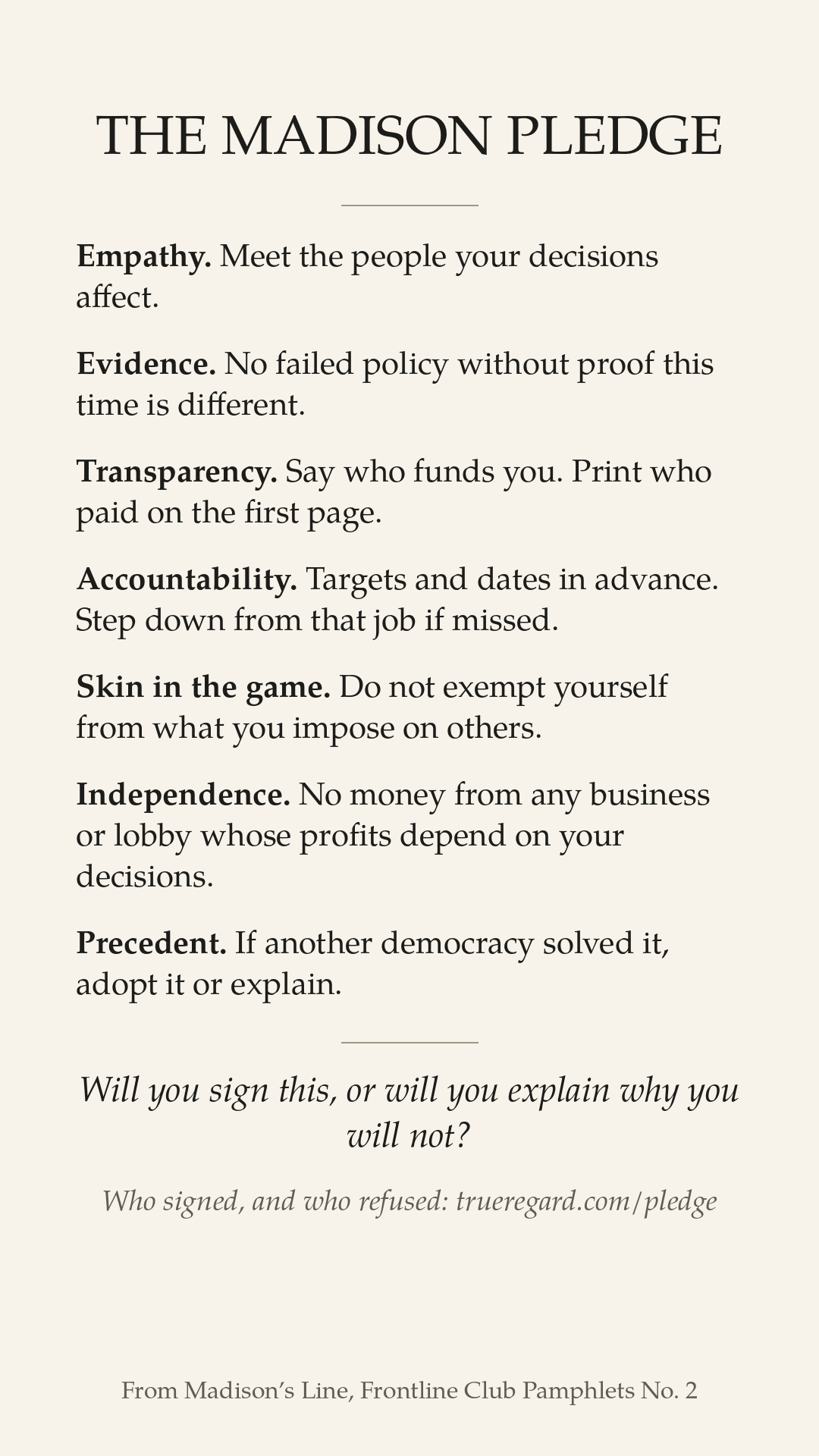
Seven commitments. Any candidate. Any election. Any country.
A hundred and fifty years ago a British reformer named Samuel Plimsoll put a mark on the side of every merchant ship: a line painted on the hull, visible from the dock, past which an owner could not load the vessel and drown the crew for the insurance. Not a plea for better men. A mark anyone could see.
The first version failed. The 1876 Act let the shipowner paint his own mark, and some painted it on the funnel. It took fourteen years to put right, and the fix was not a better class of owner but an independent table anyone could look up. The mark only worked once the owner no longer drew it. The measured must not hold the ruler.
The Madison Pledge is that line, drawn for politics. It takes its name from James Madison, who saw that enlightened statesmen will not always be at the helm, so the design must not depend on their being so. It does not ask a candidate to be a better person. It asks for a mark that cannot be faked: seven commitments, short enough to print on a card, asked of every candidate, at every election, in any country. Each is an act that leaves a record, not a claim that can be polished.
Meet the people your decisions affect. Account for the impact.
What it demands: a measurable period of time, every year, spent inside the systems the candidate proposes to govern. Not as a stunt. As a condition of representing the people whose lives those systems shape.
Do not push a policy that has failed before without publishing, with evidence, why this time is different.
What it demands: where a documented failure history exists, a published account of why the previous failure does not apply. If the account cannot be produced, the policy cannot be advocated.
Say who funds you, publish your evidence and print who paid on the first page.
What it demands: funders named on every report. Meetings in the published diary. Speech fees declared. The pledge does not prevent the writing. It requires that who paid be printed on the first page.
State the targets and the dates in advance. Step down from that job if you miss them.
What it demands: major commitments come with measurable outcomes and dates. If the outcome is not delivered by the date, the politician resigns the relevant brief. Not the seat. The brief.
Do not exempt yourself from what you impose on others.
What it demands: the architect lives inside the structure they design. Aviation runs this rule. The aviation industry is alive because it does.
Take no money from any business or lobby whose profits depend on your decisions.
What it demands: a meaningful cooling-off period, public disclosure of every employment offer and an absolute bar on taking money from any interest the politician has regulated.
If another democracy has solved this, adopt their fix or explain why it will not work here.
What it demands: where another democracy has demonstrated a working solution, any claim of impossibility must be accompanied by a published explanation of why the demonstrated solution cannot apply. If the explanation cannot be produced, the policy must be considered. The discipline does not require adoption. It requires honesty about why the precedent is being refused.
Will you sign this, or will you explain why you will not?
Carry it with you: save the card to your phone, or print it.
That is the list. It is not a loyalty test. It is seven things you are entitled to ask, and the answers, or the refusals, are information.
The register of signatures and refusals. Kept by Frontline Club Books until it needs a better home. It starts empty: no candidate has yet signed or refused on the record.
The first entry is the register itself. It is kept for now by Frontline Club Books, the pamphlets’ publisher: a line drawn by its owner, which fails the Pledge’s own test. It is held here until a better home can be found, and it will be handed over the day there is one.
While the register is being built, signings and refusals can be reported to info@trueregard.com with the candidate's name, the office sought and the date. Confirmed entries are logged here and dated. Versions of the Pledge for other democracies are in development; if you are building one, write in.
| Date | Candidate | Office sought | Signed or refused |
|---|---|---|---|
| No signatures or refusals recorded yet. | |||
Asked a candidate? Put the answer on the record. Entries are checked before they are published, and a refusal is published in the same form and the same place as a signature. Nothing is removed once entered; a correction is a new entry saying so.
Anything else, including a challenge to an entry, to info@trueregard.com.
The Pledge is presented not by a party but by citizens, to every candidate, at every election. The structure is yours to build.